“… slowly departing, (…) melting into the horizon …”
From France to Kazakhstan by land

If you’re new here, welcome!! My name is Nono and I play music as Nono Gigsta. For some time now, Golden Plains has tried to book me for the closing set of their festival in Australia. As I live in Europe and have been avoiding planes since 2019, the invitation seemed impossible to honour. After having initially declined, I started doing research on what a flight-free trip down south would actually entail. Realising how delicate this may be … only grew my eros towards the endeavour.
Fast forward and here I am, writing from Almaty (Kazakhstan). Slowly yet quickly, weeks thickened with ever-changing smells, novel sounds and dozens of newsletters’ worth of plot twists every time I cross another border.
I’ll share a few today. I’m a little drowsy. But, safe, healthy, thankful and, as ever, reflective. I’ve also been wondering it there is anything in particular you’d like to read about this experiment? What's relevant to us in this time?
By the way, when I sent my last newsletter, my inbox suddenly refused to receive emails. The issue has now been solved but some communication has been lost forever. If I haven’t gotten back to you, this may be why. And if you can't read this email properly, you'll find the archive here.
Hungary, Romania, Bulgaria
I left home on Friday, the 25th of September with my best friend, who was joining me for the first part of the journey before taking trains back to Marseille. Ugo and I travelled via Switzerland where yet another wildfire was disturbing train trafic. After we were rerouted, we managed to catch the night train towards Hungary where I was playing my first gig.
Waking up in Budapest, we headed towards to the promoters’ flat, who looked onto the Danube. The levels of the second longest River in Europe dropped to exceptional lows this summer, revealing the rock of starvation: “If you see me, weep”.
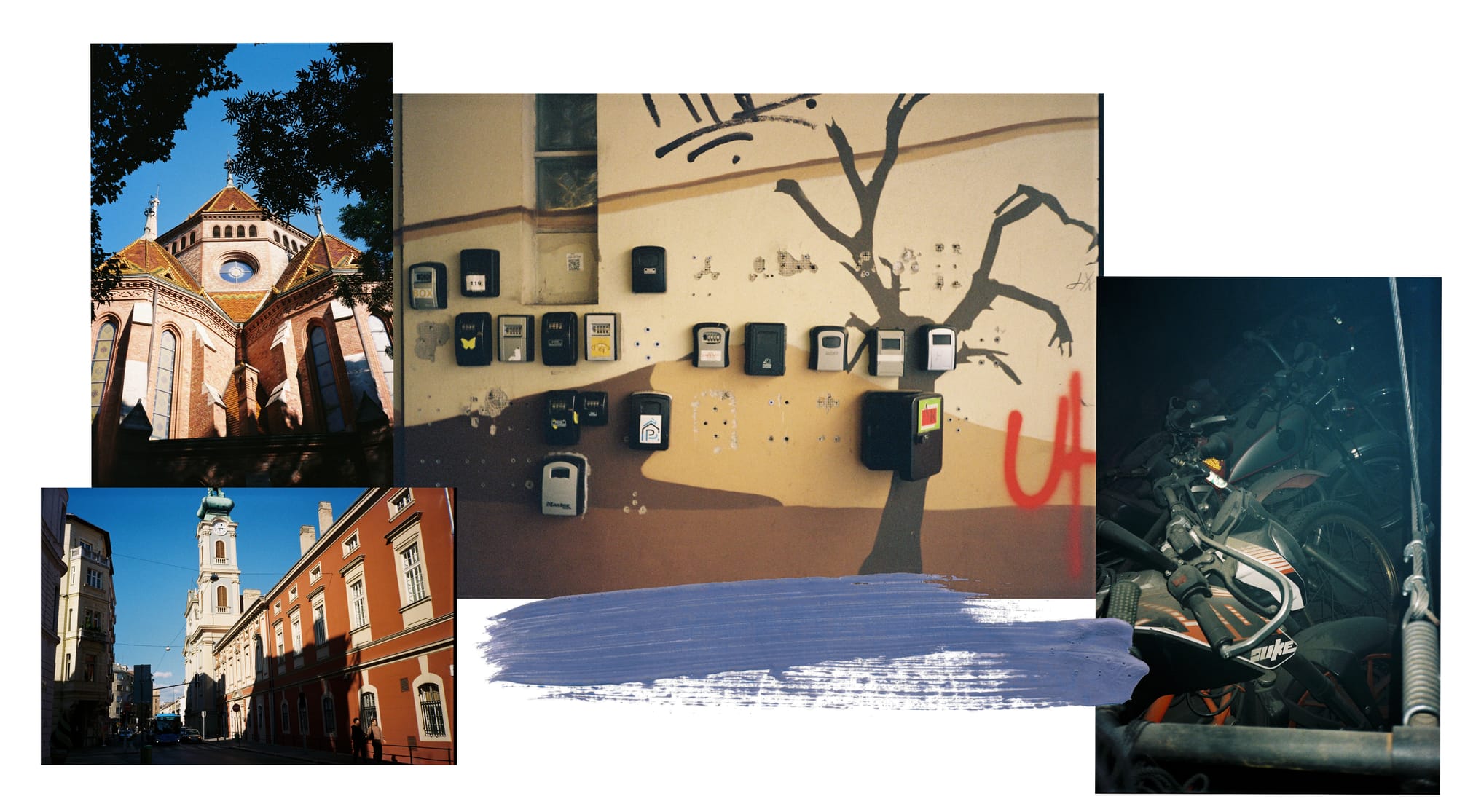
We spent the day shaking off the last 24h spent in wagons by walking around. The Hungarian capital has been trying to upmarket from its reputation as cheap weekend destination and although rents, restaurants and bath houses have all become more expensive, the streets remain filled with stag parties. Quite frankly, if I wasn’t a DJ, city trips probably wouldn’t be what would move me (let alone my best friend) through the world. Yet there was something charming about the baroque architecture, ornate facades and extremely walkable streets.
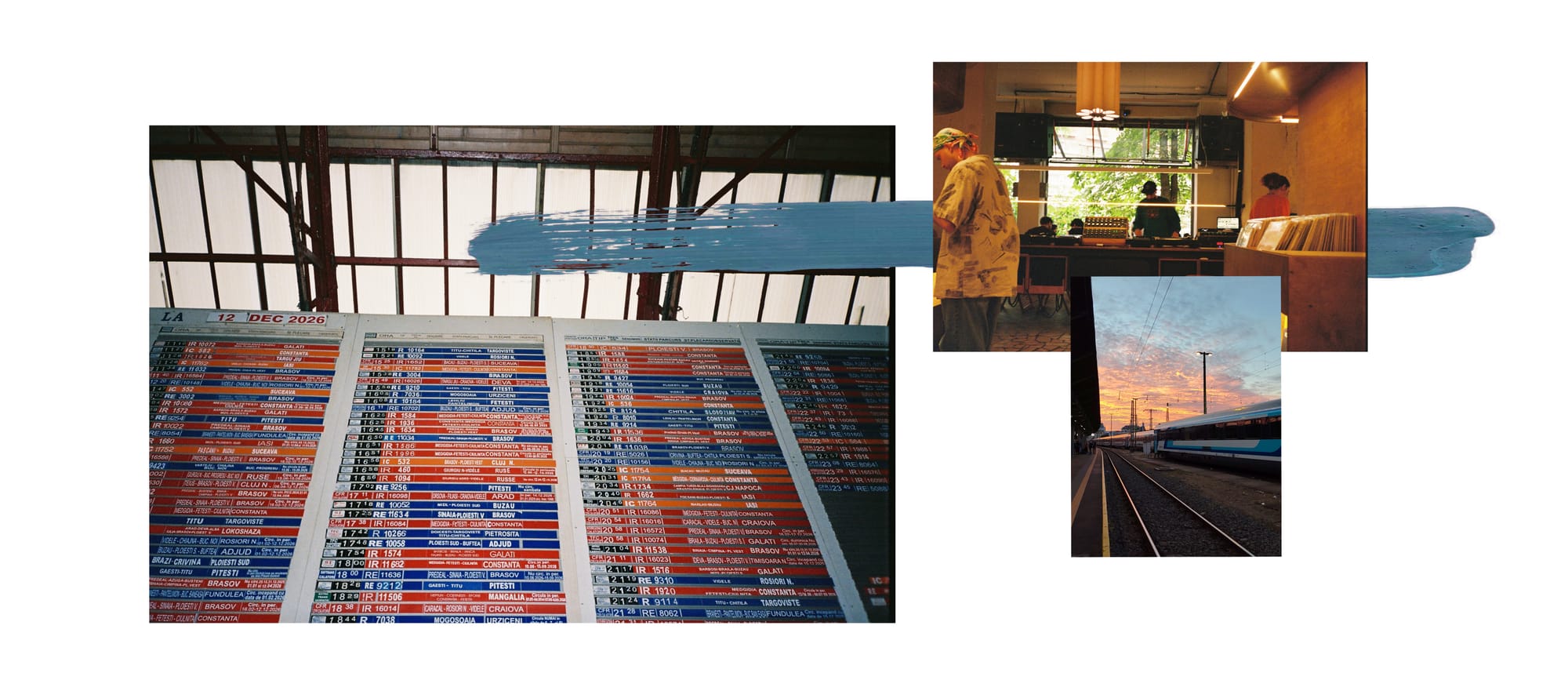
Located further out, Atno is an outdoor-indoor venue in a warehouse. Some motorbikes from the former repair shop are still hanging out on the first floor whilst the ground floor now hosts a record shop, a dance floor, a bar with a comfortable seating area and a courtyard. The event that Saturday span over 12h including workshops, barbecue and a live concert—the whole thing amounting to a community atmosphere that contrasted starkly with the airbnbified city center. I was booked from 0h30 til 2h30 alongside an (admittedly entirely male) line-up of DJs who also contributed to the space as organisers. I found myself playing an unexpectedly deep set, carried by a truly amazing custom-made sound system. Tip!
As a sublime sunset illuminated the train station of Budapest the following evening, Ugo and I continued our way towards the East. I started reading Liliana Corobca’s novel Too Great A Sky set during the deportation of Romanians to Kazakhstan during the Soviet era. In the first chunk of the book, the narrator recalls the month spent in a railcar (“The train was slowly departing, it was melting into the horizon”). Passengers fought hunger by telling stories to each other (“Those who didn’t tell stories died”). Those deaths come with many details in the novel, too.
The “Ister” sleeper train between Budapest and Bucarest felt decadently luxurious in comparison. We even had a little sink in our room and the views of the Carpathians in the morning were worth the “slowness”. We spent the day in the Romanian capital with a quick visit at Bar Ton, where Radu gave me some recommandations for a radio show that I am currently working on.
Our third night in transport was less comfortable as we took a bus across Bulgaria and toward Istanbul. Sleep was no option as we were stopping every other hour for toilet breaks or various border controls. The good news: it is possible to travel this chunk during the day and a direct train between Bucarest and Istanbul does exist during the summer.
Turkey
Ugo and I arrived in Istanbul on Tuesday, as I was booked later that night in a small club called Sahika. It was so wet that day that the event was sparsely attended. Two weeks later, when Ugo would travel back home the same way, he’d witness the city under torrential rains. At least eight died because of the floods.
Istanbul is often described as a doorway between Europe to the west and Asia to the east, with the Black Sea to the north and the Sea of Marmara to the south. A liminal zone, both literal and internal, was being crossed. We’d been on the road for only four days, but home was already starting to feel very, very far away, with every landscape standing between us and the familiar.
Travel, perhaps especially grounded travel, has a distinctive psychedelic feeling. As I discussed the idea of “psychedelia beyond drugs”, with a friend, she came up with the concept of “the infinite party of the psyche”. In experiencing so much of the Earth and its people over such a short span of time, Ugo and I started sensing a nearly hallucinatory effect on our thoughts, feelings and behaviors.
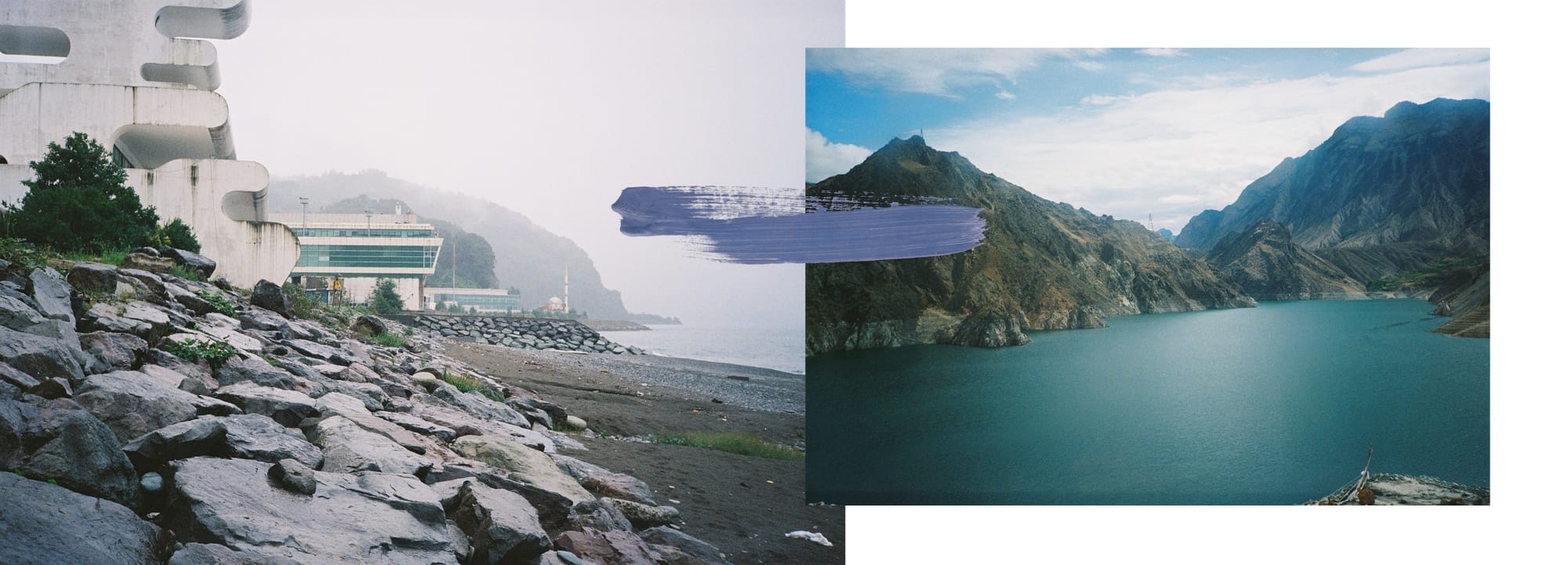
While this expansion was sometimes accompanied by euphoria, it also triggered vertigo and despair. There hadn’t been a situation where extractivism wasn’t directly or indirectly sensed. This had absolutely nothing to do with Turkey being more or less industrialised than other places, but it might have something to do with the scale of some of the sceneries we traversed there and the grief that comes with that.
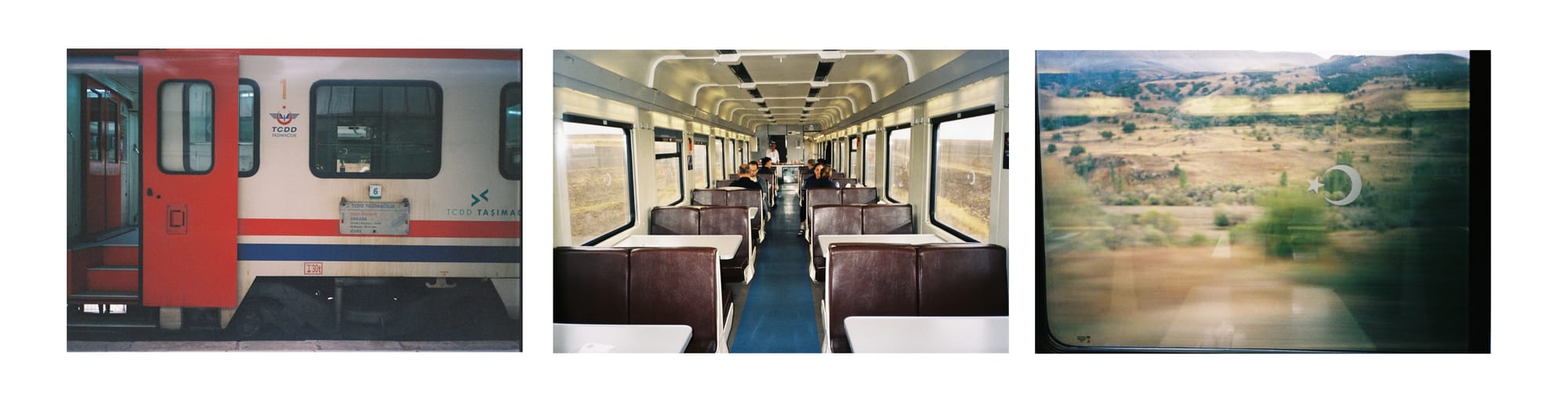
We took a train from Istanbul to Ankara (an exact copy of the Deutsche Bahn trains), then bordered on the infamous, and hiiighly recommended (though Diesel powered) Dogu Express for 24h. We spent most of it watching desert, canyons and rivers from our couchettes. After a night spent in Erzurum on Thursday, we took a bus on Friday towards Hopa, witnessing the texture of the mountains morphing from dry to lush as we approached the Black Sea.
Wasn’t I the tiniest molecule in this immense, immeasurable, ever-evolving metabolism? And how could such small things be the vehicles for such colossal scars? There was barely a stretch of train track that wasn’t bordered by trash, a mountain that hadn’t been wounded, or a lake that wasn’t being exploited for this or that purpose. I felt ridiculous with my little filter, refusing to buy bottled water while encountering plastic everywhere, from Gallia to Anatolia. It was like an altered state, as if I were trapped in corridors of ornamental slightly ominous shops and an uncontrollable sprawl of manufactured goods—even trains made me uneasy.
 outlines
“We’re a civilisation so deeply powered by and dependent on fossil fuels, and more… We’ve gone really far with all this,” Ugo mused.
It wasn’t some kind of Paris syndrome; rather our psyche downloading the weight and actuality of modernity into new corners of our bones.
Armenia
The Armenia-Turkey land border has been closed since 1993. Turkey has been imposing a transportation and economic blockade against Armenia and Nagorno-Karabakh and pressuring Armenia into abandonning its pursuit of international recognition of the genocide. While the Dogu Express could have brought us not too far from Yerevan, we had to take a bus up North to the Black Sea, cross between Hopa and Sarpi, take a bus to Batumi, a bus to Tbilissi and another bus to Yerevan, the whole thing amounting to two very dense days.
After the last passport control of that stretch, our bus stopped by a gas station and Charles Aznavour’s “Emmenez moi” was the first song I heard in Armenia. This was odd because so much felt unfamiliar—the overheard conversations, the alphabet, the snacks—but the music in the shop didn’t. It was doubly odd because the song was everywhere in French media around that time, as students were singing it in the protests that had started mid-September and which were facing increasingly violent repression from the police. As I’m writing, France has imposed an overnight curfews in several cities.
Born in France from Armenian parents (Aznavorian), Charles Aznavour is considered a hero in Armenia, a country that gained its independance in 1991, shortly after the dissolution of the USSR.
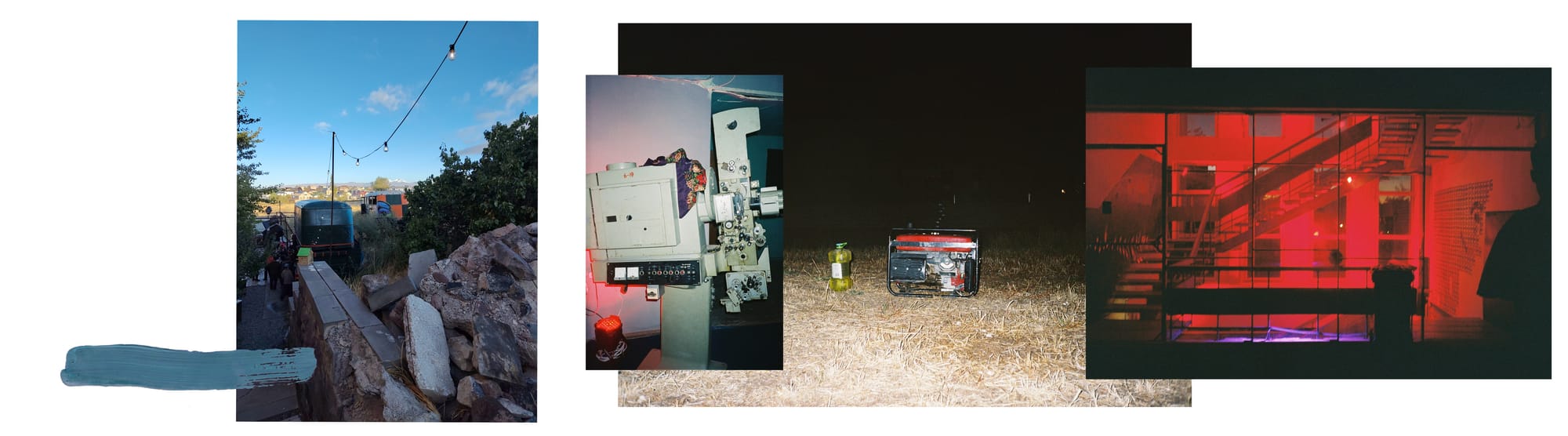
Having swirled between the gorgeous hills of North Armenia, our bus dropped us in the capital later that day. Ugo and I left our backpacks at Varoujan’s and reached the Cascade Memorial to the Victims of Soviet Repression and Deportation, an imposing monument that sits on top of the iconic Yerevan stairs. NOPA festival had programmed several artists to perform that night but there had been issues with the electricity. Eventually, the organisers had had to figure out a generator set which they installed just outside the monument. “Welcome to Armenia” said Ani, aka Missteik, one of the co-curators of the festival.
The dance program was booked at MOCT, the club venue in Hayfilm Cluster. Both the outside and inside of the building were incredibly stylish. Missteik and I were playing b2b for the closing set in the garden. A gorgeous sun was rising and a snowy Mount Ararat appeared in the back. Ararat came under Turkish control during the 1920 invasion and although lying outside the borders of modern Armenia, the “mountain of Noah” the principal national symbol of the country and considered sacred.
Georgia
We travelled back to Georgia a few days after the festival, taking the very recent and fancy night train between Yerevan and Tbilisi.
Twenty years ago, around 560,000 international visitors arrived in Georgia each year. By 2025, the country recorded a 7.8 million international visitors and estimated 5.5 million of those were tourist-type visits. This dramatic growth followed a carefully planned, state-led rebranding effort. Perhaps the country had not anticipated the scale of gentrification in some districts, including Chugureti where we were staying. Overtourism and an influx of Russian residents are making the city less affordable for Georgians.
The weekend of our stay, Bassiani, the techno club that contributed to Tbilisi’s reputation as “new Berlin”, was celebrating its 12th anniversary. A few days later, I’d meet Hamatsuki, a resident at the venue, who described the birthday celebration as one of his favorite, with people crying during µ-Ziq’s live set.
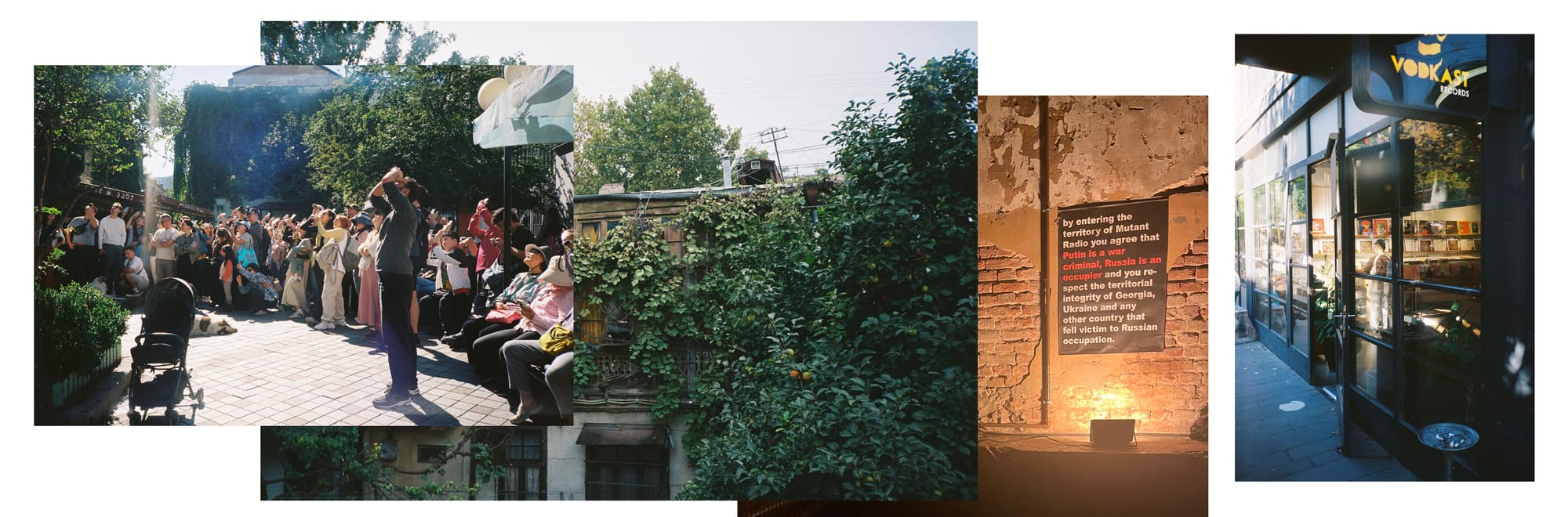
Mutant Radio, whose studio is based just around the corner, was also organising a charity event which we visited before heading to Left Bank, where I was playing the first slot. I feared the club may be empty with so many other offerings in town but the dancefloor quickly filled up. “It’s a slightly different crowd than Bassiani, or sometimes people come to Left Bank first and go there later. Georgians love to party”, someone explained before adding: “On one side, some queer people left since the Georgian Dream party came to power. On the other, we have a very international crowd, a lot of Brits.”
It was one of the most joyful gigs I played in a while and the vibe remained upbeat after my set. Ugo and I would have stayed until the morning if it wasn’t for the early bus I was having to take to Vladikavkaz. That was where our journeys parted.
Russia
Many reflections about this part of the trip. But the full story might have to wait til I get home. Some day.
For now: I had managed to find a companion to do the crossing and on the way, we met a third backpacker headed towards Asia. In my professional life, I’m often the odd one out. But Georgia into Kazakhstan was a funnel for the current flight-free Europe-to-Asia route. On either side, I kept bumping into travellers who weren’t on long journeys but rather on loooooong journeys. And even so, everyone always knew of someone else who’d done it in even crazier ways.
I was increasingly aware of this social group as they’d started appearing in my researches, the platform I’d joined and the algorithms that ensued. I’d come to assume that they were often gen-Z descendants of the hippie generation turned into mostly white straight couples with a well-documented polarsteps account and a deeply engrained desire to show everyone else that “look, it’s actually possible”. Yet, I also came to meet much queerer and humbler adventurers.
As for my getting-in-and-out-of-Russia companions, it was interesting that they both cared about climate and social justice issues but had additional motivations for the transport they chose and risks they took. One wanted to see and feel more on the way. The other one said he wanted to check the Earth was actually round. “Nah i’m kidding” he added, before correcting again “Well, I’m kinda not.” He chuckled. That guy chuckled a lot.
Kazakhstan
On a panel Beatrice M and I participated in, the French-British dubstep producer compared slow travelling to a muscle that requires training and stretching. They explained that longer journeys was something they’d had to learn, distances that seemed tough had now become more feasible and enjoyable.
I think my longest train journey so far had been New York City to Portland in 4 days with a stop over in Chicago. I wasn’t too intimidated by the 52h train that crossed Kazakhstan from West (Atyrau) to East (Almaty), especially since I could afford a couchette, which hadn’t been the case in the US.
Although the land of North America seemed galaxies away now, the imperial project it currently hosts couldn’t feel closer. A few months ago, Trump cut a $1.1 billion tungsten deal in Kazakhstan that stood to profit his son. “Cooperation, security, innovation ….” Beneath it lay the old question of what extraction leaves behind, and who gets to call it progress.
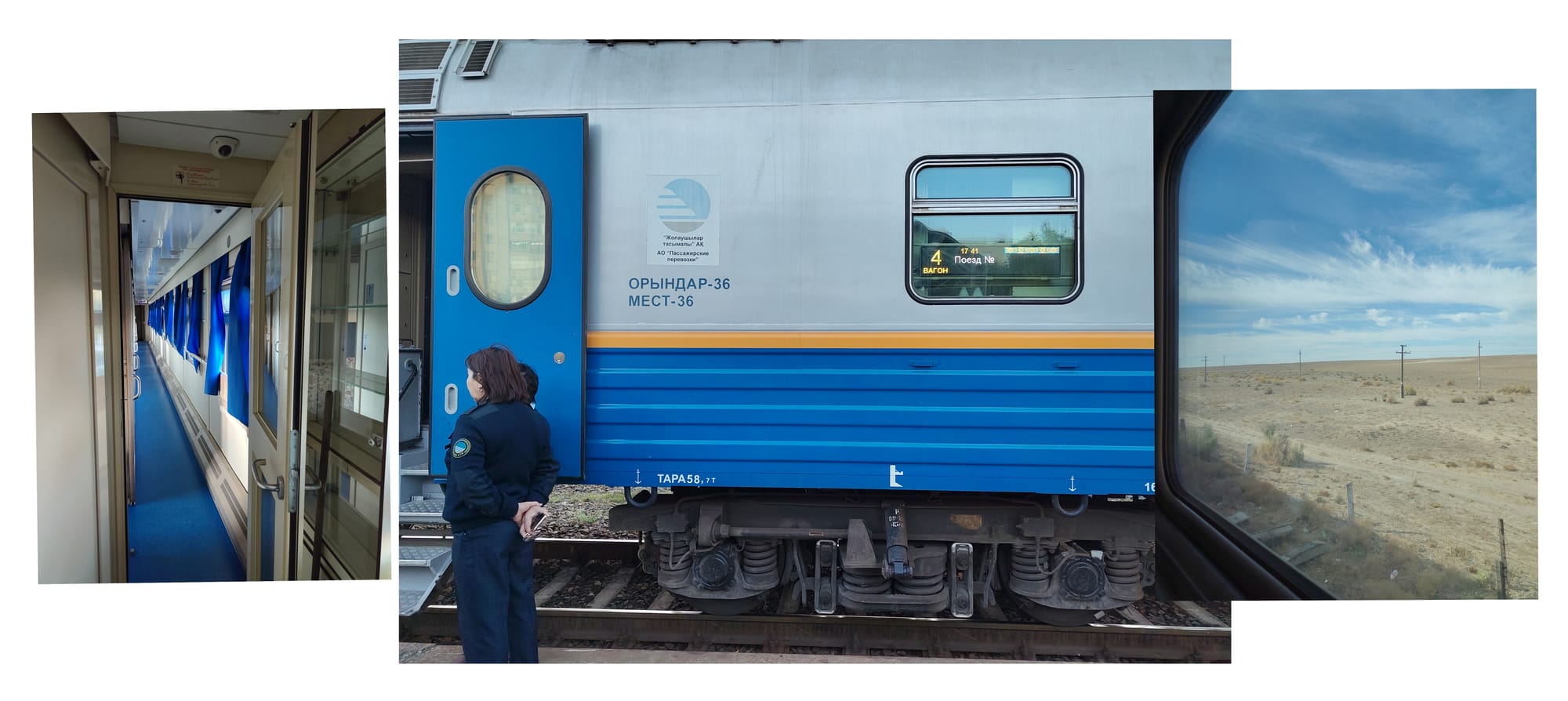
The idea of mining the land feels increasingly violent when you spend so much time with it. The views on the first day stretched flat to infinity, broken by sparse vegetation and occasional patches of salt through the sand. Hours would pass before we came across a village, though there were wild horses and camels, sometimes a lone cemetery. There was no restaurant car, but the train stopped at villages where stalls appeared just as we passed through. A timetable in the corridor listed the length of each stop. During the longer ones, a train attendant would walk alongside the tracks, tapping the underside of the train with a long metal stick to check whether anything needed attention. I tried to get onto the platform as early as possible, not wanting to miss a single clang in the whole melody.
On the second day, snowy mountains appeared in the distance, and yurts sometimes dotted the steppes.
Later that night, I reached Almaty, the largest city of the 9th biggest country in the world. Making my way towards the center despite the apparently habitual traffic jams, I arrived in time to attend Nazira’s party which, interestingly, gathered “artists from the silk road” including CEM, LIUYANG, Msiyan, DJ AKEE, E.T., milktea, Apolla, Arsen Superfly, SAMRATTAMA, Bismildin and Nazira herself. The event was supposed to happen in Almaty’s historic Kök Bazaar but the same morning, the authorities changed their minds about the permits given and Zvuk had to relocate to Colossus Space for vague reasons. “This isn’t Europe”, Nazira told me.
The day after, I met up with a bunch of Almaty promoters who discussed the difficult economics of organising underground music events in Kazakhstan and the issues when trying to tour to other places with a Kazakh passport. “Wouldn’t it be nice to be born in the Global North and you can just decide to take trains for as far as you want?” one of them asked while looking at me. My main challenge then was to try and figure out how to enter India by land and it was driving me fairly crazy. His question put my frustration into perspective. As did many other things during this trip.
Further reflections
My friends regularly ask me if I’m “enjoying the journey”. I am. I can’t think of anything else I’d want to be doing right now. Even there is grief, even if there is doubt.
With all my privileges and all the distance required, I also need to be honest about the labor implied. With every border, I need to adapt to whole new systems (cultural particularities of course, but also new e-sims, different digital maps, chatting apps, money currencies, booking platforms, etc.) The biggest challenge is that as soon as I have decent internet access, I’m having to figure out how to arrange multiple next steps: check border situations, find the bus journeys that are often not documented online, find accommodations last minute according to the unpredictabilities of the schedule, etc.
AI sucks at most of this. I know it because people whom I’ve shared the road with and who relied on it got their itineraries wrong. There are too many moving parts (weather, geopolitics) and most of the resources aren’t documented in the places AI draws information from. It’s on discord, it’s on analog documentation in the city you’ll visit, it’s stored in the people who live there or have done this. Even research engines won’t get you very far. I have no idea how well AI does for other ways of travelling but if you want to avoid planes on very long journeys, you have to walk up to people and actually talk to them. That, I love!
Still, figuring out how to go to places is my main job at the moment and it’s not even the only one. The other flight-free travellers usually have the freedom to stay longer and move their days around. Meanwhile, I’m trying to make it in time for gigs, not to mention preparing them, and play them, and all the social aspects around. In fact, I’ve dealt with the admin of all the gigs I’m playing in October and November. My agent might help with some later. Sometimes I wonder if I'm making the best use of my time on Earth, especially when all the work falls apart. But aren't we all wondering??!
Whenever I do have time with music though, it’s felt extra special. Truly!!
I’m not saying all this to complain. I just want be open about the scalability and sustainability of slow gigging, rather than romanticising it. My hope is that this experiment can help others, open up conversations and be a space to cultivate divine qualities. This croco is resilient to challenges, workloads and uncertainties.
A doubt lingers, as to whether my actions are actually honouring the people and places as much as my heart longs for. And I think writing this newsletter really helps with that intention. So thank you, thank you so much, for reading.
Coming up
23.10 - Blue Bar, Almaty, Kazakhstan
24.10 - Open House, Bishkek, Kirghizistan
China
14.11 - India
20.11 - India
Nepal, China
26.12 - Vietnam
Thailand, Malaysia, Singapore, Indonesia
07.03 - Golden Plains, Australia
23.04 - China
24.04 - China
South Korea, Japan
A bonus bit of fiction
There’s a bit in Too Great A Sky that particularly touched me. Having finally arrived in Kazakhstan, the train leaves the narrator and other deported Romanians in a cold hostile night. They start dancing: “Tudoriţa began to dance amazingly too, the way she whirled around and all her different steps! We couldn’t stop marveling . . . She got warmed up and started taking off some of her clothes. She’d go up to some child who was more lightly dressed with a headscarf or blouse and put it over their shoulders or tie it around their waist, while the horă kept going. (…) She danced a bit more, then she left the circle, she laid down on the cold grass and breathed her last. When we came over to her, we saw that she had died with a smile on her lips. What a beautiful death! We danced some more.”
A request
We’re looking for a venue to organise our meditation retreat again, ideally in France. Tips or ideas welcome!
A cheeky photo of le nono
This pic is for paid-subscribers only, please don’t share outside and in general, please don’t post pictures/videos of my face. Merciii
xxx n